

Have you ever noticed that after a few months, a raise doesn't feel like a bonus anymore? You're earning more than you used to, and yet that nagging feeling that it's not enough lingers.
You’re not alone in this. More than four in ten Dutch households (44 percent) are financially vulnerable or financially unhealthy, according to a study by Deloitte in collaboration with Nibud, Tilburg University, and Leiden University (April 2026). But financial stress and money worries also affect people who, on paper, seem to be getting by just fine. That says something: having enough isn’t just a matter of numbers.
In this article, we’ll explore where that feeling comes from, why earning more rarely solves the problem, and what you can do to find peace in your relationship with money.
Why do you always feel like you don’t have enough money, even when you earn enough? The short answer: money is being used to solve a problem that money can’t buy, such as recognition, security, or the feeling that you matter. As long as that’s the case, no amount of money will ever feel like enough.
Why is money never just money?
Money seems like a rational thing. It’s a number in your bank account or an amount on a receipt. Yet we rarely make decisions about money based purely on reason. How you save, spend, share, or hold on to money bears the marks of your upbringing, your culture, what you’ve lost, and the expectations you’ve been taught.
Financial life strategist Zola Kai spoke with thirteen people about their relationship with money for her book *Alchemical Rhythm*. In all those stories, she saw the same pattern: money almost never stands alone. It represents security, dignity, control, recognition, loyalty, or freedom. As long as money is meant to fulfill one of those needs, no amount will ever be enough.
Think of someone who grew up with parents who expressed love through gifts rather than through time and attention. Or someone who, as a child, felt that there was never enough. That kind of experience sticks with you. As an adult, money then remains something that must provide protection or serve as proof, even when the bank account has long since been replenished.
What are you really looking for when money never feels like enough?
Ask yourself what would change if you earned twice as much tomorrow. Would you feel seen, safe, or valued? Or would that feeling of inadequacy just come back after a while?
According to Zola Kai, “enough” doesn’t start with an amount of money, but with recognition. People who don’t feel recognized by a partner, an employer, or even themselves often try to compensate by working harder, earning more, or acquiring possessions that show they’re doing well. But the problem is that recognition can’t be bought. That’s how money and self-worth become intertwined without us even realizing it.
You see that same pattern in people who are always there for others. Those who feel responsible for their household, their family, and their coworkers soon find that money is like a bottomless pit. There’s always someone who needs something. Without boundaries, being of service becomes a source of exhaustion, and the feeling of scarcity persists.
Men who see themselves as the breadwinners are familiar with this, too. In many families and cultures, there is still an expectation that the man will bring home the money. That pressure says little about the amount of money, but a lot about what someone feels they are supposed to be.
Why does earning more rarely solve the problem?
Our idea of success often revolves around having more: a bigger house, a newer car, a higher salary. But wealth is not the same as well-being. Those who pursue wealth in the hope that well-being will follow automatically may find themselves in an endless cycle.
Add to that lifestyle inflation: your spending usually keeps pace with your income. What was once a luxury becomes the norm. That sense of financial breathing room then disappears just as quickly as it appeared. Does that sound familiar?
Sometimes, that sense of lack isn’t just a feeling—it’s reality. Anyone who grows up without a safety net, burdened by student debt and without financial reserves, rarely has truly free choices. In that case, it’s not a matter of thinking differently, but of a system that leaves little room to breathe. That, too, deserves to be honestly acknowledged.
How can you find peace in your relationship with money?
There’s no one-size-fits-all roadmap. Zola Kai emphasizes that change doesn’t start with judgment, but with awareness: seeing what’s there and where it comes from. So a different mindset about money doesn’t come from being hard on yourself, but from looking at things with curiosity. In the book *Alchemical Rhythm*, the stories of the thirteen interviewees serve as a mirror. You’ll recognize yourself in them, without anyone telling you what to do. A few questions from their stories can help set you on your way.
The next time you make a purchase, ask yourself whether you want something or really need it. It’s not about denying yourself something. It’s about noticing what happens when you pause for a moment. Are you looking for convenience, comfort, a reward, or the desire to fit in?
Another way is to convert a large expense into hours worked. How many hours of your life will that new car cost you? And what could you do with that same money to create a memory with someone you love? That way, money becomes something you use for what matters to you.
Take a moment to reflect on what you learned at home. What did you hear about money as a child? Maybe it was “money doesn’t grow on trees” or “don’t get into debt.” Or maybe the topic was never discussed at all. Phrases like these often continue to influence your choices, without you even realizing it.
Talk about it with your partner, too. A lot of tension around money in relationships isn’t caused by not having enough money, but by unspoken expectations. Who pays for what, and who makes the decisions? And does that feel fair to both of you? Equality doesn’t have to mean splitting everything exactly in half. It’s about consciously sharing the burden together.
And finally: Can you justify your spending to yourself? Not to your parents, your neighbors, or your followers, but to yourself. If the answer aligns with what’s important to you, you’ll feel at peace—even if the amount isn’t large.
From scarcity to abundance: What can money actually give you?
Money will never feel like enough as long as you expect it to solve problems that money can’t solve. Recognition, security, and the feeling that you matter aren’t found in your bank account. Once you realize that, you can let money be what it is: a means to live in a way that suits you.
Zola Kai puts it this way: money brings peace of mind when it feels right, not when there’s a lot of it. What would change for you if, starting today, you stopped asking whether it’s enough and started asking whether it feels right?
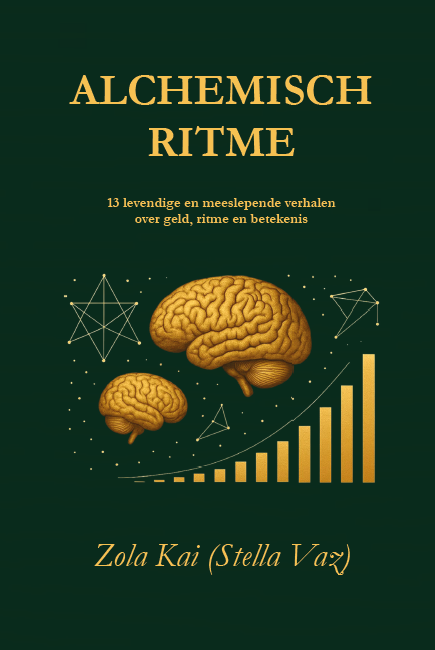
Take the Initiative in Your Relationship with Money
Would you like to explore your own relationship with money more deeply? Then read *Alchemical Rhythm* by Zola Kai. Thirteen people share how their relationship with money was shaped by their background, upbringing, culture, and loss. Each story is followed by an analysis, lessons, and questions to help you get started on your own. And you’ll also receive those lessons and questions as a PDF workbook, so you can get started quickly and practically and gain insight into your own alchemical rhythm—and what’s still holding you back or where you’re getting in your own way.
"Alchemical Rhythm " is available exclusively through our online store, with the PDF workbook included as a bonus.

About Zola Kai
Zola Kai is a financial life strategist. She helps people discover their own rhythm when it comes to money, so that their financial lives align with who they are.